
A Homeowner's Guide to Heat Pump Water Heaters:
Efficiency, Value, and Long-Term Performance
11/24/20257 min read
1.0 Introduction: The Modern, Smarter Way to Heat Your Water
Since their introduction around 2010, heat pump water heaters (HPWHs) have evolved from a novel, early-adopter product into a mature and highly reliable technology. The noisy "Gen One" models of the past have given way to refined units now in their fifth or sixth generation from established brands, while new manufacturers continue to enter a competitive market. This brief will provide a clear understanding of how these advanced systems operate, their substantial benefits, and what to consider for a successful installation that ensures a long and reliable service life.
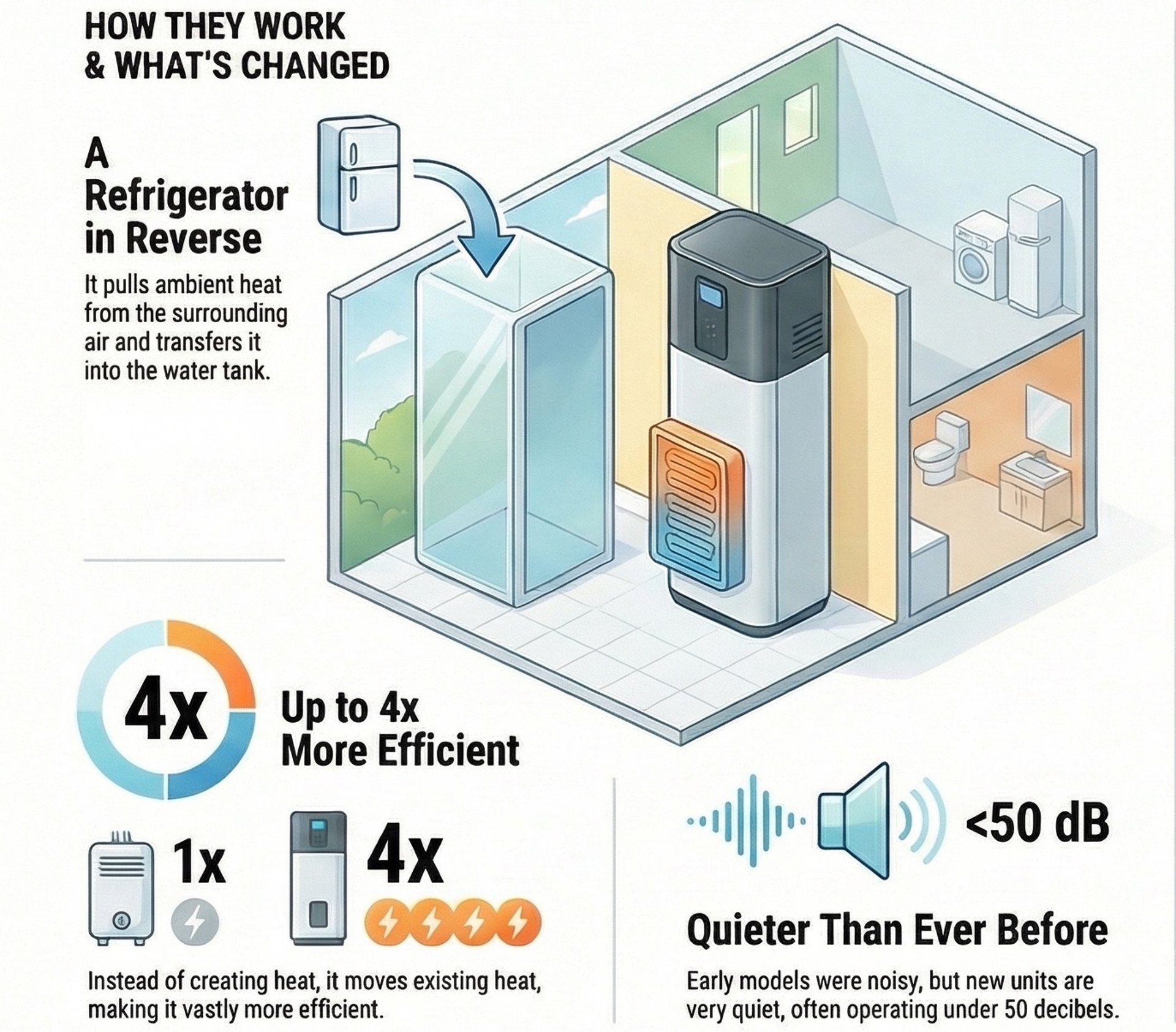
At its core, a heat pump water heater operates on a principle that is already familiar and proven in every home: refrigeration. Just as your refrigerator works by moving heat out of its insulated interior to keep your food cool, a HPWH does the reverse. It pulls existing heat energy from the surrounding ambient air and efficiently transfers it into the water stored in its tank. This simple, elegant process of moving heat—rather than creating it from scratch—is the key to its remarkable efficiency.
This fundamental difference in operation is what makes the technology a superior choice for the modern home, delivering significant energy savings and long-term value.
2.0 Unlocking Superior Efficiency: How It Works
Understanding how a heat pump water heater achieves its high level of efficiency is essential to appreciating its value over conventional systems. This operational advantage is the primary differentiator and the foundation of the long-term savings it provides. The key lies in the fundamental difference between creating heat and moving it.
A standard electric resistance water heater, much like a common hairdryer, creates heat by passing electricity through a coil. This process is 100% efficient at converting electricity directly into heat. A heat pump, however, doesn't create heat; it concentrates and moves existing heat from one place to another. This method is dramatically more effective, allowing a modern HPWH to operate with a close to 4:1 efficiency ratio. In other words, for every unit of electricity it consumes, it moves nearly four units of heat energy into the water, making it about four times more efficient than a standard electric model.
The physical unit itself is composed of two primary, reliable components: a heat pump unit with a compressor on top and a standard water storage tank on the bottom. This is proven, durable technology, functionally identical to the heat pump that has reliably powered household refrigerators for decades. This high operational efficiency translates directly into significant benefits and cost savings for the homeowner.
3.0 Key Considerations for a Successful Installation
Proper placement is the single most critical factor in ensuring a heat pump water heater operates at peak performance and delivers its full efficiency potential. Understanding the unit's spatial and environmental requirements is essential for a successful installation and helps avoid common performance issues.
Spatial and Airflow Requirements
HPWHs require a significant volume of ambient air to function correctly. This is not a system that can be installed in a small, sealed closet without special accommodations.
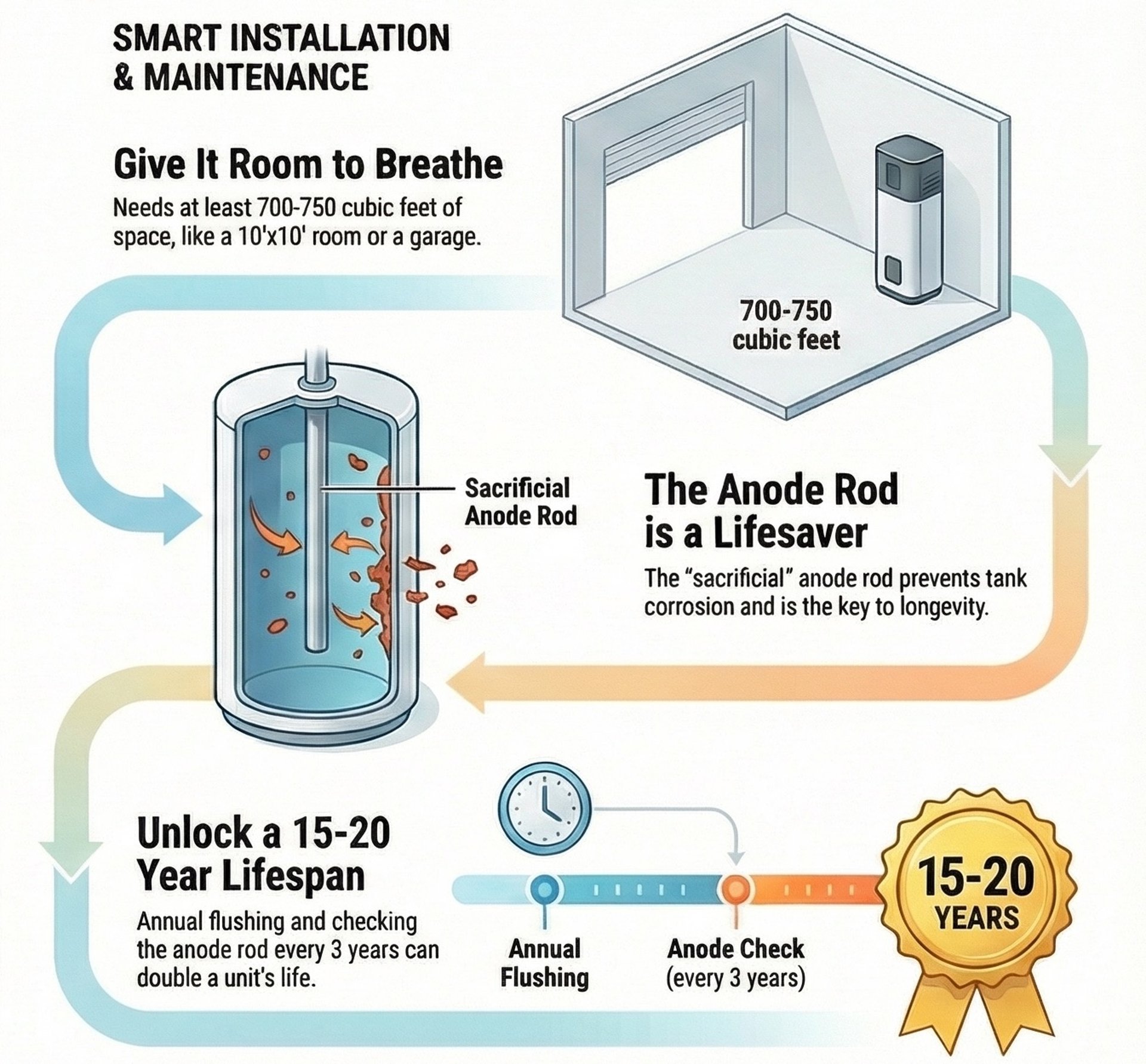
1. Required Air Volume: A typical HPWH needs access to approximately 700 to 750 cubic feet of surrounding air. To put this in perspective, a 10x10 foot room with an 8-foot ceiling provides 800 cubic feet of space.
2. Consequences of Improper Placement: Installing the unit in a small, unvented closet will starve it of the ambient heat it needs. The unit will exhaust cool air, causing the small space to become cold quickly, which drastically reduces the system's efficiency and performance.
3. Ideal Locations: The best installation spaces provide ample air and ambient heat. Excellent locations include a full basement, a garage (especially a hot one in southern climates), or even an old, leaky farmhouse basement where there is plenty of air exchange.
Ducting for Confined Spaces
If an ideal open space is not available, ducting provides a flexible solution. Most units can be ducted to draw air from an adjacent room or a larger space (like a garage) and then exhaust the resulting cool, dehumidified air to another location. Some models feature intuitive, built-in connections for intake and exhaust ducts. For others, it’s a critical purchasing decision point. Homeowners should check specification sheets for "integrated duct connections," as choosing a model without them may add cost and require more installation space due to the adapter kit.
Plumbing and Build Quality
Practical design features can affect the ease of installation and long-term reliability of the unit.
• Water Connections: Units with top-mounted water connections are often easier to install, particularly in retrofit situations where they are replacing a conventional tank with the same layout. Models with side-mountedconnections can require more horizontal clearance for plumbing, potentially making installation in tight spaces more challenging.
• Build Quality and Materials: From a professional's perspective, overall build quality is revealed by the small details. Look for units that use no plastic fittings for critical connections. Components made of solid brass or stainless steel, particularly the drain valve, are a non-negotiable feature. They are far more durable and prevent service headaches down the road, ensuring long-term reliability.
Careful planning around these installation factors sets the stage for the unit's long-term performance and ease of maintenance.
Proper installation is critical to performance and efficiency, which is why working with an experienced Plumber in Columbia Missouri is strongly recommended for heat pump water heaters.
4.0 Maximizing Your Investment: Longevity and Maintenance
A heat pump water heater should be viewed not as a disposable appliance, but as a long-term investment in your home's infrastructure. While many conventional water heaters are replaced within a decade, a properly maintained HPWH can deliver reliable service for 15 or even 20 years. A lack of basic care is the primary reason for premature failure; as professionals in the field often note, "a typical American is replacing their water heater within a decade because there's no maintenance done." This extended lifespan is achievable through simple, consistent maintenance, centered on protecting the tank from corrosion.
The Role of the Sacrificial Rod
The primary defense against internal tank corrosion is the sacrificial anode rod. This is a metal rod, typically made of magnesium or an aluminum/magnesium composite, installed inside the steel tank. Water is naturally corrosive to steel, and when combined, the two create a chemical reaction like a giant battery. The anode rod is designed to be more chemically reactive than the steel tank lining, so it corrodes first—sacrificing itself to protect the tank's interior.
The manufacturer-recommended maintenance schedule for these rods is critical for extending the life of the tank. They should be inspected at least every three years and, at a minimum, replaced by year six. It is important to note that this is not a simple task on an HPWH, as it requires removing the shroud around the top-mounted heat pump unit to access the rod.
Advanced Anode Rod Technology
Modern units offer advanced solutions that simplify this crucial maintenance task, moving beyond the traditional "dumb" anode rod.
• Powered Anode Rods: These electronic systems provide continuous protection without degrading over time. They are a low-maintenance alternative that eliminates the guesswork and routine replacement required with traditional sacrificial rods. Some premium models now ship with this technology pre-installed.
• Anode Sensor Alerts: To further simplify maintenance, some models are equipped with sensors that actively monitor the anode rod's condition and alert the homeowner when service is required.
In addition to anode rod care, the tank should be flushed of sediment annually. This simple procedure ensures that heating performance remains optimal and contributes to the overall longevity of the system.
5.0 Performance and Sizing: Ensuring a Plentiful Supply of Hot Water
A primary concern for any homeowner is whether a new water heater can provide an ample and reliable supply of hot water. Through proper sizing and modern features, a heat pump water heater can comfortably meet the demands of even a large family.
Sizing and Capacity
While the "first-hour rating" (the amount of hot water a unit can supply in an hour of high demand) may differ from a traditional gas unit, HPWHs are designed to provide plentiful hot water. For instance, larger 80-gallon models can deliver 80 to 90 gallons in the first hour. Personal testimony confirms their capability; as one expert with a family of six notes, "I have an 80-gallon heat pump at my house...and I have never run out of hot water." It is essential to follow manufacturer guidance to select the correctly sized tank for your home's number of bathrooms and occupants.
For homes with exceptionally high demand, some models offer the flexibility to increase the water temperature setting, with some units capable of heating water up to 150°F. On many units, this is a simple adjustment made by changing a dip switch setting. This creates a larger reservoir of usable hot water when mixed with cold water at the tap, providing an extra buffer against running out.
A Quiet, Modern Experience
The user experience has also evolved significantly. The "Gen One" models from 2010 could be quite noisy in operation. Today's units, however, are engineered to be very quiet, with many operating at under 50 decibels—a sound level comparable to a quiet conversation. This ensures the unit can be installed in a basement or garage without creating a disruptive noise source. These advancements in performance and user experience make the HPWH a seamless and powerful addition to the home.
6.0 Conclusion: A Future-Ready, High-Value Upgrade for Your Home
The modern heat pump water heater is an exceptionally efficient, reliable, and long-lasting technology that delivers significant long-term value through substantial energy savings. With proper installation and routine maintenance, it represents one of the smartest infrastructure investments a homeowner can make.
Adopting an HPWH is also a forward-looking decision that aligns perfectly with the growing trend toward high-performance, all-electric homes. For homeowners considering or already using solar power, the technology is an ideal fit. The key is its dual-power nature: the heat pump itself has a very low power draw—typically around 500 watts—which is highly compatible with a solar array. This contrasts sharply with the high-wattage backup electric resistance elements, which are used only for very high-demand recovery. This low, steady power consumption for primary operation makes it a perfect match for on-site energy generation.
By offering superior efficiency, long-term durability, and future-ready technology, the heat pump water heater has firmly established itself as the premier, high-performance standard for water heating in the modern home.
Professional Installation Matters
Heat pump water heaters require careful planning, proper venting, and code-compliant installation to operate efficiently. Incorrect sizing or installation can reduce performance and shorten the lifespan of the system.
Highline Plumbing specializes in water heater installation and replacement for homes in Columbia, Missouri. Our team ensures your system is properly installed, meets local code requirements, and operates at peak efficiency. Whether you’re upgrading for energy savings or replacing an aging unit, working with a qualified Plumber in Columbia Missouri ensures the job is done right the first time.
